
A Deep Dive
The spec sheet: behind the glass & glow
Love the technicalities? Same. While you don’t need to know the science to love your gallery, understanding the engineering behind our toolkit explains why our images feel different. Consider this the “All-Access Pass” to our signature style.

Cameras
The “brain” of the operation: the camera body
Our Camera Lineup: 10 Master-Class Nikon Bodies
If you’ve ever wondered why your phone photos or a standard "starter" camera looks a little flat compared to professional work, it usually comes down to the sensor. Think of the sensor as a window—the bigger the window, the more life (and light) it lets in.
1. The "Crop" vs. The "Full Frame"
Most entry-level cameras use what’s called a "Crop Sensor." It’s like looking at the world through a porthole. It’s fine for a quick snap, but it "crops" out the edges and struggles when things get a little dark.
Our Nikon Z-Series (The Full Frame): We use professional Nikon Full Frame bodies (like the Z6, Z7, and Z8). These have massive sensors—imagine a floor-to-ceiling panoramic window. This bigger "window" allows us to capture a wider view, richer colors, and that "expensive" look that smaller cameras physically can't see.
2. Meet the "Z-Squad" (Z6, Z7, Z8)
We don’t just have one camera; we have a specific "tool" for every part of your day. Each of these Nikon powerhouses has a "superpower":
The Nikon Z6 (The Night Owl): This is our low-light champion. When the lights go down for your first dance, the Z6 "sees" in the dark without making the photo look grainy or messy. It keeps things clean and romantic.
The Nikon Z7 (The Detail Obsessed): This camera is all about resolution. It captures so much detail that you could blow up a photo to the size of a billboard and still see every individual thread in your veil. It’s for those "hero" shots you’ll hang on your wall forever.
The Nikon Z8 (The Speed Demon): This is the powerhouse of speed and smarts. It can track an eye through a crowded room or catch a split-second laugh before it’s gone. It’s basically a super-computer that happens to take world-class photos.
3. Why This Matters for You
At the end of the day, you aren't paying us for the "box with a button." You’re paying for the technology that ensures even if the lighting is tricky, the room is crowded, or the moment is fleeting, your photos will be crisp, colorful, and high-end.
We invest in the best "brains" in the industry so you never have to worry about "if we got the shot." We did.
Lenses
The “why not just zoom?” question
Our Glass Lineup: 20+ Curated Prime & Zoom Lenses
If you’ve never picked up a professional camera before, we get it—it’s hard to understand what the ‘mm’ after those lens numbers mean or the 1.2 that follows. In theory, it would be easier to just slap on a zoom that can do them all, right?
On paper, a “do-it-all” lens sounds like the ultimate hack. It’s handy, it’s fast, and it covers the range. But here’s the thing: a lens that does “everything” in reality does nothing perfectly.
The lenses we bring into the room aren’t the ones you’ll find on the shelf of a big-box store. We invest in top-of-the-line, professional "glass"—specifically the Nikon Z-Series S-Line and the legendary Plena. These are lenses in the $3,000 range, and we carry them for three very specific reasons:
1. THE "LIGHT" SECRET (The Physics of the Z-Mount)
Nikon’s new Z-Series isn't just a new camera; it’s a total redesign of how light enters the lens. The "mount" (the opening where the lens meets the camera) is massive, which allows us to use glass that "sees" in the dark. While an entry-level lens struggles the moment the sun goes down, our high-end glass pulls in massive amounts of light. This is how we get those crisp, clear shots in a candlelit reception without the "grainy" look of a photo taken on a phone.
2. THAT DREAMY BLUR (Enter: The Prime lens)
You know those photos where the subject pops and the background looks like a soft, watercolor painting? That’s called bokeh. To get it, you need specialized lenses that can open up wide.
While a standard zoom lens "flattens" the image, our prime lenses—like the Nikon Plena—are engineered specifically to create the world’s most perfect background blur. The Plena is widely considered one of the best lenses ever made; it creates a "soulful," three-dimensional depth that an all-in-one zoom physically cannot replicate. It’s the difference between a snapshot and a masterpiece.
3. PRECISION OVER CONVENIENCE
Think of a zoom lens like a pair of "one-size-fits-all" pants. They work, but they don't fit perfectly. A "Prime" lens (one that doesn't zoom) is custom-tailored for a specific job.
Because it doesn't have to move back and forth, every single piece of glass inside is optimized for one thing: unmatched sharpness. When you use a $3,000 lens dedicated to a single focal length, every eyelash, every tear, and every lace detail is captured with a clarity that a "do-it-all" lens simply loses in the shuffle.
We don’t choose our gear based on what’s easy to carry—we choose it based on what creates the most breathtaking gallery.

Flashes
The “Glow-Up”: Why we don’t use “the pop-up”
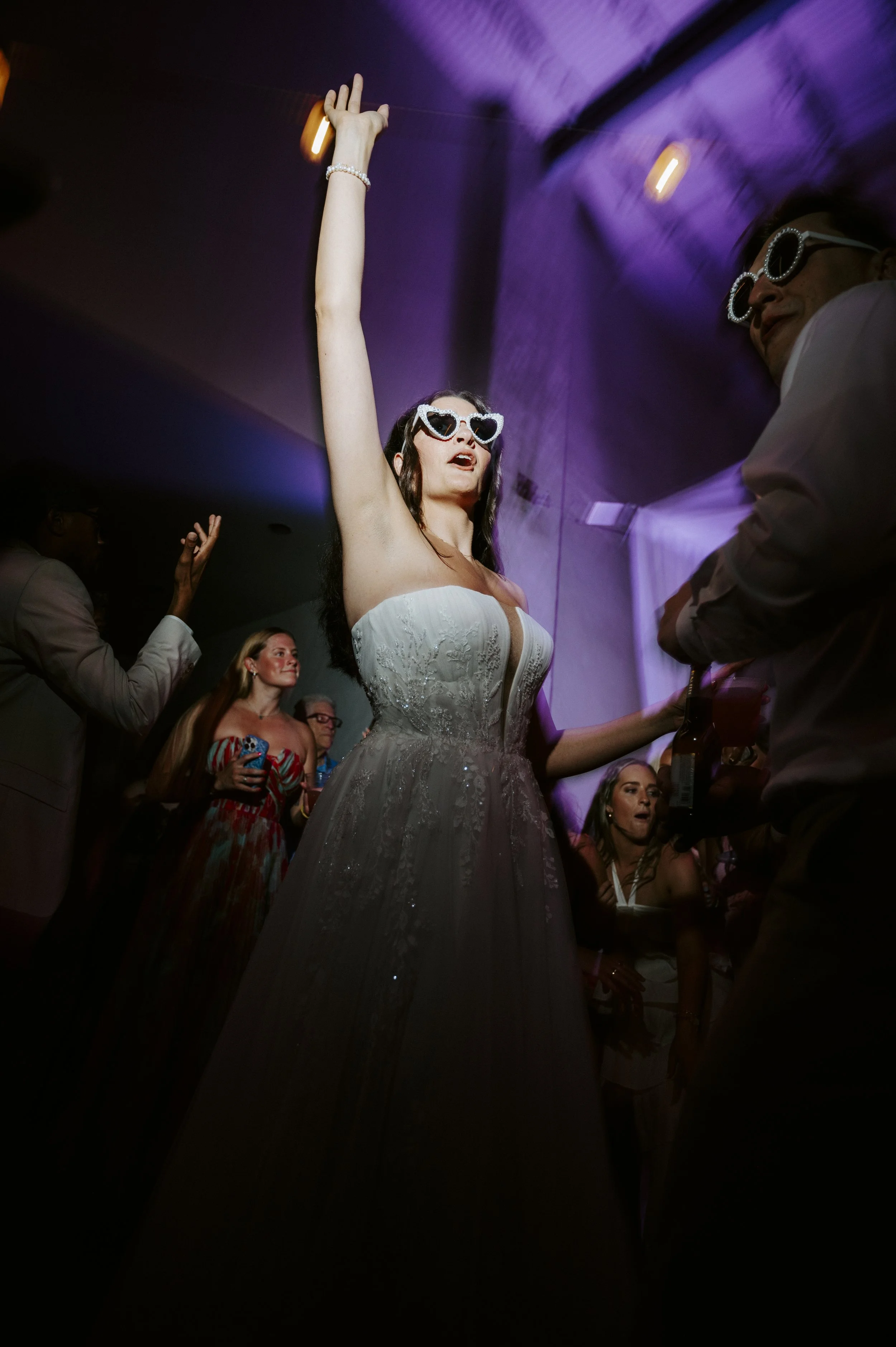
If the lens is the eye of the camera, the lighting is the mood. You’ve probably seen a flash and thought, "Ugh, no thanks—I’ll look like I’m being interrogated at the DMV."
And honestly? You’re right. If the flash is used wrong, it’s a disaster. Here is why our gear is a totally different animal:
1. The "Deer in Headlights" vs. The Soft Glow
You know that tiny little flash that pops up on top of a basic camera? We call that the "vibe killer." It hits you right in the face, flattens your features, and makes everyone look like they just saw a ghost.
Our Fix: We use professional-grade lights (shoutout to Godox) that are essentially high-performance studio lights in a portable body. But the real magic is the modifier.
The Lampshade Analogy: Think of a bare lightbulb in a dark room—it’s harsh and hurts your eyes. Now, put a beautiful, high-end lampshade over it. Suddenly, the whole room is soft, warm, and flattering. That’s what our "modifiers" do. They turn a harsh spark into a soft, "glow-from-within" light that smooths out skin and makes your eyes sparkle.
2. Off-Camera Magic (The "Expensive" Look)
If you’ve ever wondered why a photo looks "professional" while a guest's iPhone photo looks "flat," the secret is usually Off-Camera Flash (OCF).
The "3D" Effect: Instead of keeping the light on top of the camera (which hits you flat-on), we move it off to the side on a stand.
Why it Matters: This creates subtle shadows that define your cheekbones and jawline. It adds depth. It’s the difference between a flat piece of paper and a beautiful sculpture. It makes you "pop" off the background so you don't just blend into the scenery.
3. Mastering the Sun
Ever tried to take a photo in front of a beautiful sunset, only to end up as a dark shadow or a giant white blob?
The Pro Move: This is where our technical gear shines. We use our lights to "talk" to the sun. We can light you perfectly while still keeping that deep orange and purple sky behind you. It’s how we get those "epic" shots that look like they belong on a movie poster.
The Bottom Line: We don’t just use flash to make it "bright"—we use it to make it "art."
The Signature Edit
Beyond a filter: Where Editorial Depth meets luminosity
While our cameras, lenses and lighting provide the technical foundation, our editing process provides the curated finish that defines our aesthetic.
One of the biggest misconceptions in photography is that we just "slap on a filter" and call it a day. In reality, we’ve spent years developing our very own Proprietary Color Profile. This isn't a one-click-fix we bought online; it’s a custom-engineered look designed to ensure your memories feel timeless, not trendy.
1. Years in the Making
Our signature look was built from the ground up. We’ve spent years fine-tuning how skin tones look under candlelit receptions, how whites stay crisp in the mix of the muddled colors of the dance floor, and how colors remain vibrant. It’s an intentional, hand-crafted process that ensures your gallery looks like you, just on your very best day.
2. the “editorial” balance
Most "Bright and Airy" photos suffer from one major flaw: they lose the detail. The whites get "blown out" and the blacks turn into a muddy gray.
Our Approach: We’ve perfected a look that is luminous but grounded. We keep the images bright and colorful, but we protect the "blacks" and the shadows. This is what gives our photos that Editorial Edge—the richness of a fashion magazine with the light, airy feel of a romantic wedding day. You get the glow without losing the detail.
3. The "Pixels vs. Paper" Science
There is a massive technical gap between how a photo looks on a glowing phone screen and how it looks on your living room wall.
The Screen Lie: Some photographers edit for the "backlight" of a phone. But because paper doesn't have a lightbulb behind it, photos that look good on screen can often come out dark and flat when printed.
The Print-Ready Promise: Our Signature Profile is meticulously calibrated for both. We’ve engineered the brightness levels so that the "airiness" you see on your screen translates to physical paper. Whether it’s a digital gallery or a high-end heirloom album, the richness and the glow remain exactly as intended.
4. A Look That Doesn't "Expire"
By avoiding the "trendy filters" of the moment, we ensure your photos won't look "so 2026" in ten years. We edit for longevity, luminosity, and luxury.
We didn't buy this look; we built it and tailored every shadow with quiet intent.